

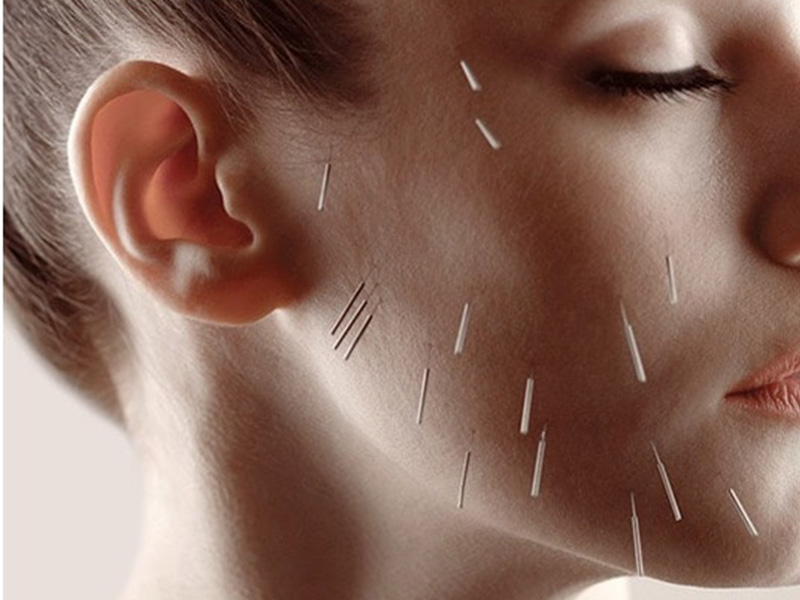
Acupuncture
Acupuncture begins with a thorough examination of the patient by an acupuncturist doctor after (following necessary laboratory and radiological tests) a diagnosis is made. The patient is laid down on the examination table face up or face down depending on the location of the illness and the condition of the patient. They can also be seated if preferred. There is a wide variety of needles used in the practice, with the most commonly used being steel needles.
These needles are almost as thin as a hair and at the same time very sharp. They are applied subcutaneously or into the muscle by the acupuncturist using a very special method without any pain. These points may be stimulated for 20–30 seconds and then removed.
After the needles are applied, the patient is typically treated by lying down for 15 to 45 minutes in a calm cabin or room.
The length of the needles ranges from 0.5 to 8 cm. Their thickness (diameter) varies between 0.16 and 0.5 mm. Needles are generally disposable or sterilized using an autoclave (a system used for operating room sterilization).
The number of sessions in practice varies depending on the type and duration of the disease and the age of the patient. This can range from 3 to 30 sessions or even longer in some cases. Typically, 7 to 12 sessions are considered as a course of treatment.
There is a break of 5 to 10 days between each course. The length of the courses is adjusted according to the course of the disease. In some cases, permanent needles (needle-shaped staples) may be applied to the ears for 5 to 15 days. Subcutaneous needles, called intra-dermal, can be applied and left for 1 week.
Additionally, laser therapy can be applied to acupuncture points (especially in children, elderly patients, and those with needle phobia).
Electro-acupuncture (applying alternating current to points, low voltage and amperage) can also be applied to acupuncture points. The frequency varies between 2 and 2000 Hz (electrical stimulation given per second) depending on the condition of the disease.
Electro-acupuncture was first applied in China in 1958 during tonsillectomy for pain relief. Also, sound waves (sono) are also applied.
Regardless of the method used in treatment, the aim is to stimulate the acupuncture point. Sometimes, we unknowingly stimulate these points by applying pressure or massage almost every day. (For example, when the front of our head hurts in the evenings, we take off our glasses and stimulate the inner starting point of our eyebrows with our index finger and thumb.)
Sometimes we also have our shoulders rubbed by our loved ones in the evening, or we get a massage on our waist.
Applied Methods
– Needle
– Laser
– Ultrasound (Sound wave)
– Electro-acupuncture (Applying alternating current at specific voltage and frequency to the point)
– Moxibustion (Using a plant called Artemisia Vulgaris to heat the point)
– Cupping (Applying vacuum to the point for a certain measure and duration)
– Tuina, An-Mo, Acupressure (Massage application to acupuncture points)
– Injection of certain drugs into acupuncture points (Normal saline, vitamins, etc.)
– T.E.N.S (Transcutaneous electrical nerve stimulation): Applying electrical current through paddles without piercing the skin.
Types of Acupuncture
– Body Acupuncture: Points on the body are used. WHO (World Health Organization) officially recognizes 361 points and there are also about 50 additional points.
– Ear Acupuncture: It has been found that more than 150 ear acupuncture points are effective, as recognized by the WHO.
– Facial Acupuncture: Specific areas on the face.
– Nasal Acupuncture: Particularly researched by American Doctor Ralph Alan Dale.
– Foot Acupuncture
– Hand Acupuncture: Suchzok Acupuncture